01
Proven AI stalls
The top barrier to AI adoption is data quality (49%), not algorithms.
MediPipe organizes reports, readings and clinical notes into standard tables and asks clinicians only about suspect values. Patient data never leaves the hospital.
AI-ready data — clinician-verified data AI can use right away
Non-reimbursed market entry tripled hospital adoption of medical AI in about a year, and the government opened 62 hospital data-cleansing projects for 2026.
The top barrier to AI adoption is data quality (49%), not algorithms.
Data prep takes 63–80% of a research project’s timeline.
Values are copied into spreadsheets, and every project starts over.
Clinicians don’t type — they only confirm.
Reports, readings, spreadsheets — as-is
Into the same clinical fields
Clinicians check only suspect values
CSV · JSON (FHIR planned)
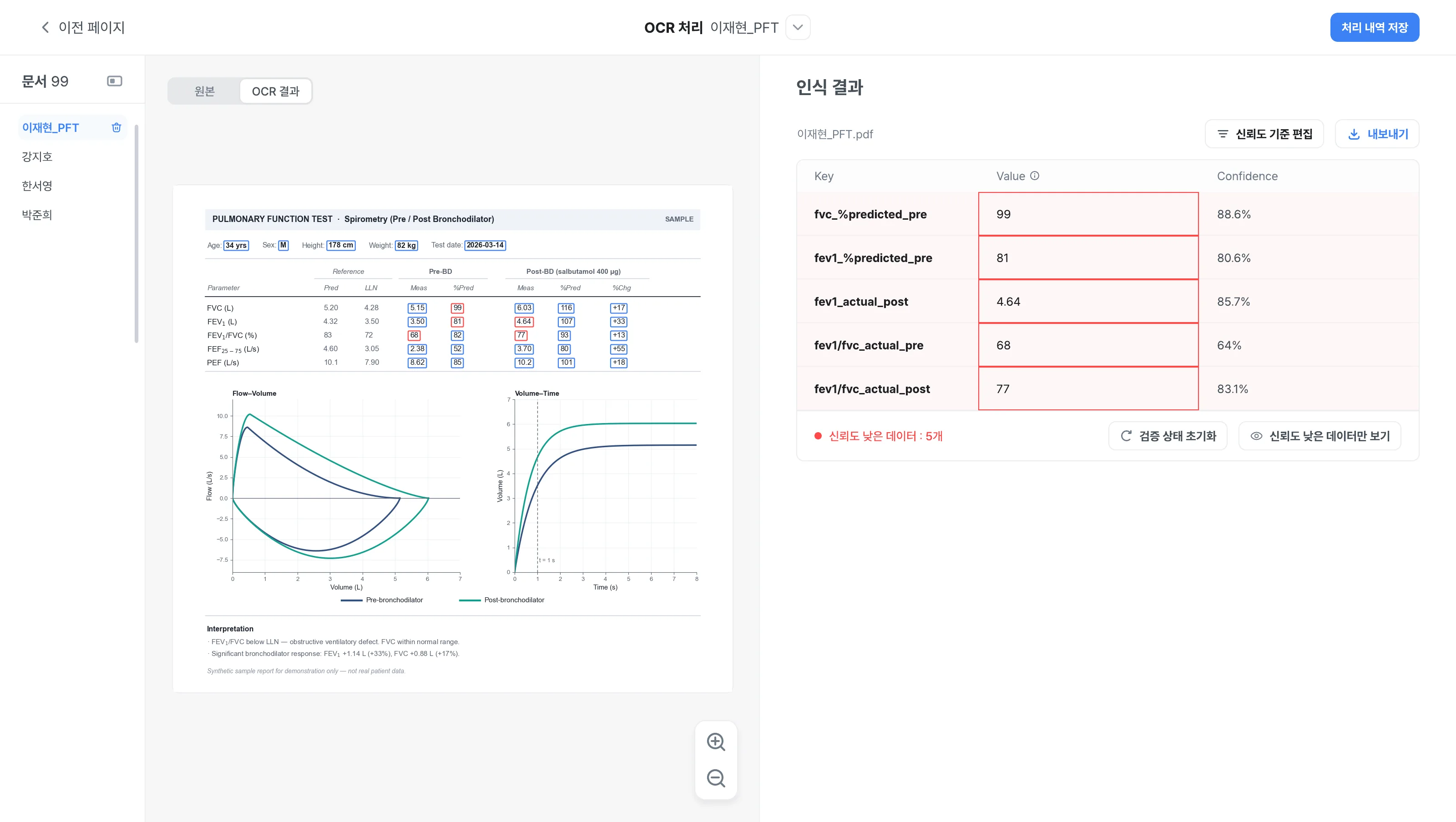
MediPipe review screen — each value is shown in place on the source, with low-confidence values flagged first.
Tap the image to view it full size.
The report and patient details shown are sample data for demonstration.
In medicine, AI that invents plausible values is not acceptable.
Catches values in the wrong field, like swapped systolic and diastolic.
Every value links to its source; nothing is invented.
Nothing is final until reviewed, with a full audit log.
Confirmations build a hospital-specific knowledge graph that becomes the next project’s rules.
Task-specific modules on MediPipe, so nothing is rebuilt per hospital.
Konyang Univ. Hospital · Pulmonary function
95.6%
Research-data prep 3 months → 4 days
Ewha Mokdong Hospital · Patients’ own medications
94.1%
Automatic conversion coverage
NHIS Ilsan Hospital · Bronchial provocation
98.9%
3 min → 2 s per report
Finished modules install as-is at the next hospital — 30 person-days down to 2–3.
98.9% is based on 2,572 reports; 94.1% is conversion-path coverage, not recognition accuracy.
2026 SPRINT Next Unicorn's Day MediPipe pitch
Korea Entrepreneurship Foundation Chairman's Award · Nov 2026
2026 SKKU Pre TeX-Corps business plan pitch
Sungkyunkwan University · Oct 2026
2026 Lab Startup Competition IR pitch
Sungkyunkwan University · Sep 2026
2026 Joint Lab-Startup Camp IR pitch
Sungkyunkwan University · Aug 2026
Multi-institution data-cleansing experience, turned into a product.
Selected publications
Deep learning models for acute kidney injury prediction: multi-center external validation and evaluation under simulated continuous monitoring conditions
Separate and joint associations of cardiorespiratory fitness and healthy vascular aging with subclinical atherosclerosis in men
Novel artificial intelligence-based technology to diagnose asthma using methacholine challenge tests
Median alert lead time tracks how long patients were observed, and runs opposite to specificity
Beyond characters — is each value in the right field?
The next hospital installs with a tenth of the effort.
Runs on segregated networks; results show in the EMR.
Swipe sideways to view the full comparison.
| Comparison | MediPipe | Generic document AI | CDW · CDM | LLM structuring |
|---|---|---|---|---|
| Input | Hospital reports · clinical notes | General documents | Structured data | Text records |
| Clinical verification | ✓ Through clinician review | Characters only | — | Limited |
| Hallucination control | ✓ No value without a source | — | — | Needs separate checks |
| Deployment | On-premise · segregated | API · cloud | On-premise | Varies |
Our first customers are department faculty running research projects. We expand from department to lab to the hospital’s AX team.
2026 estimate
KRW 3.76T projected by 2031
Departments at general hospitals and above
Pulmonology and allergy · first 3 years
Capture clinicians’ judgment as data, so every hospital delivers the same standard of care and research.
Led by a CEO who drove MFDS SaMD approvals and a quality and regulatory lead from clinical practice.

PhD student in Digital Health, SAIHST, SKKU · leads R&D

Former research nurse · quality, regulatory and research data
Advisory work has grown into deployments and purchase intent.
Adoption, research collaboration and investor materials — we’d love to hear from you.
We review product adoption and clinical or research collaboration.